|
|
NEW - The first Passive House Architecture Award in book form
 The
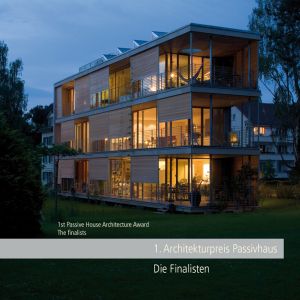
photographic volume of “1st
Passive House Architecture Award – the Finalists” documents
the 10 award winners and the 14 finalists who reached the final
round after the jury session of the Architecture Award 2010. It
has been published by the Passive House Institute with the kind
support of the Federal Ministry for Transport, Building and Urban
Development (Berlin). 50,000 copies have been published. The
photographic volume of “1st
Passive House Architecture Award – the Finalists” documents
the 10 award winners and the 14 finalists who reached the final
round after the jury session of the Architecture Award 2010. It
has been published by the Passive House Institute with the kind
support of the Federal Ministry for Transport, Building and Urban
Development (Berlin). 50,000 copies have been published.
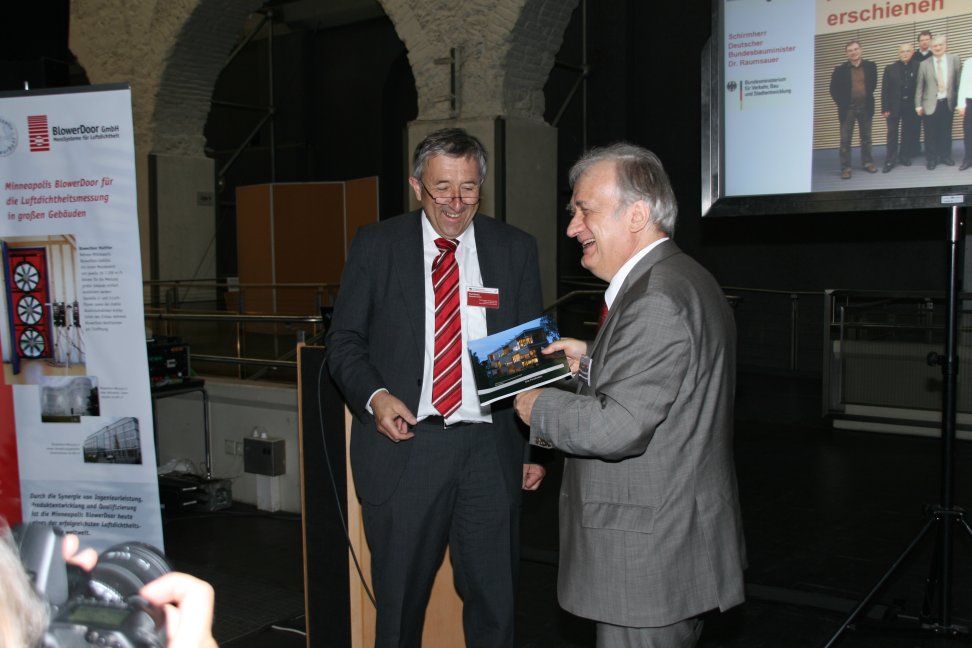 “The
results of the competition organised by the Passive House Institute
show that a high standard of energy efficiency and good architecture
are not mutually exclusive. On the contrary, they can complement
each other splendidly“, says the German Federal Minister of
Building Dr. Peter Ramsauer in the foreword. “The Passive
House concentrates on the structural details and remains consciously
aware of every architectural style, as it is beautifully clear from
this photographic volume”, adds Prof. Dr. Wolfgang Feist.
You find more Informationen here. “The
results of the competition organised by the Passive House Institute
show that a high standard of energy efficiency and good architecture
are not mutually exclusive. On the contrary, they can complement
each other splendidly“, says the German Federal Minister of
Building Dr. Peter Ramsauer in the foreword. “The Passive
House concentrates on the structural details and remains consciously
aware of every architectural style, as it is beautifully clear from
this photographic volume”, adds Prof. Dr. Wolfgang Feist.
You find more Informationen here.
2010 Passive House Architecture Award Exhibition
Good architecture is the embodiment of function, well-being and design.
On the basis of the 2010 Passive House Architecture Award
a 52 poster (59.4 x 84.1cm) travelling exhibition showcasing the project
entries of the competition’s finalists has just been created.
Reserve the exhibition
now!
All those interested in loaning out this stunning exhibition to
show outstandingly designed Passive House buildings are encouraged
to reserve a time slot by contacting iPHA at info@passivehouse-international.org.
A r c h i t e c t u r e A w a r d 2 0
1 0 P A S S I V E H O U S E
"There is no such thing as Passive House architecture – but there is a
lot of architecture with the Passive House standard."
Prof. Dr. Wolfgang Feist of the Passive House Institute in Darmstadt
The Passive House standard is not an architectural concept. It is a precisely
defined method that allows for all types of buildings to be designed in
an energy-efficient and sustainable way using well established tools.
60 architects followed the call to take part in the Architecture Award 2010 with their certified Passive House projects. The Passive House Institute has received international contributions from Japan, China, USA, Poland, Switzerland, Hungary, Italy, Denmark, Austria and Germany.
First Architecture Award for certified Passive Houses worldwide
Awarding the cream of the crop
The eight members* of the jury including Prof. Dr. Wolfgang Feist, the director of the Passive House Institute, and the elected president of the jury, Prof. Dipl.-Ing. Ludwig Rongen, awarded 4 prizes and 4 recognitions.
*Unfortunately, Prof. Manfred Hegger was unable to attend.
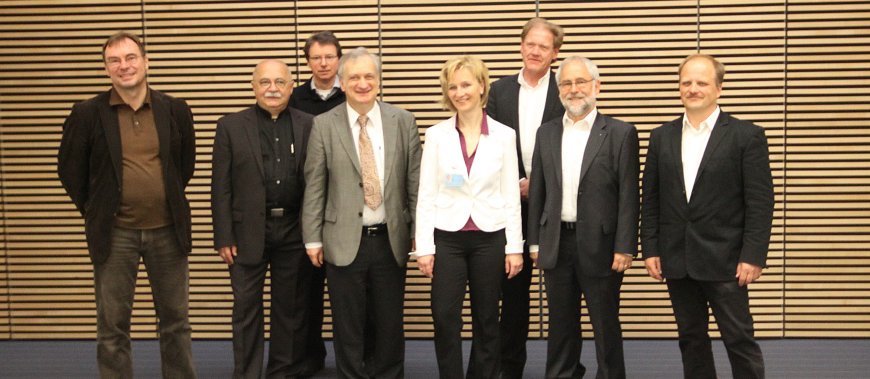
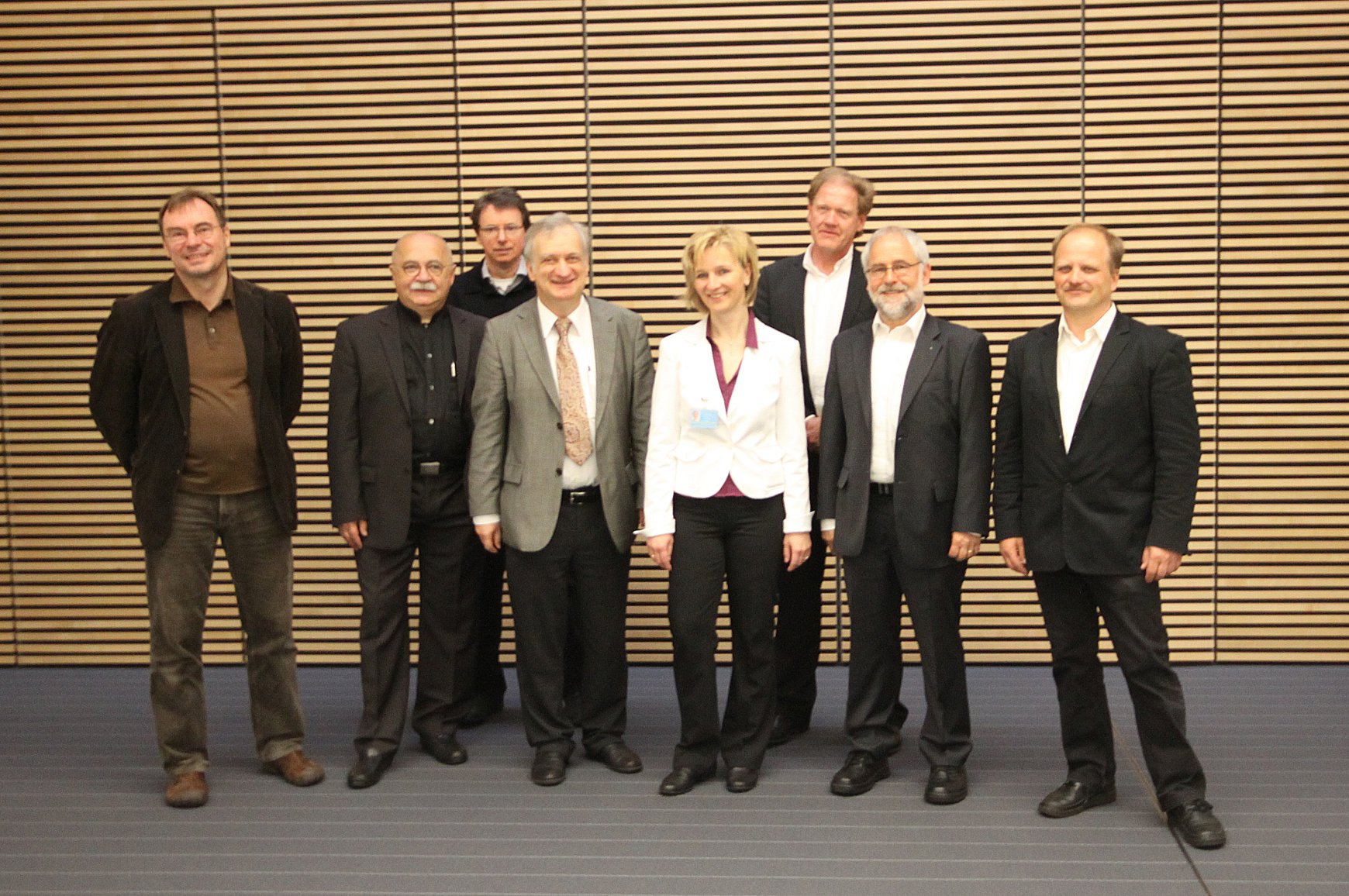
Group photo of the jury
On 29 May 2010 at the 14th International Passive House Conference, the prizes and special awards were presented in an awards ceremony by Jan Mücke, Parliamentary State Secretary in the Federal Ministry for Transport, Building and Urban Development, by Dipl.-Ing. Paul Simons, Excecutive Director of BlowerDoor GmbH and by Prof. Dr. Wolfgang Feist, the director of the Passive House Institute.
The winning projects were presented to the public at the Passive House exhibition held at the Dresden Congress Center.
The 1st prize, worth € 3,000, went to: Halle 58 Architects, Bern, Switzerland for their “Multi-Family House in Liebefeld“; project ID 1793.
The 2nd prize, worth € 1,500, went to: Cukrowicz Nachbaur Architects, Bregenz, Austria for their “New St. Gerold Municipal Centre”; project ID 1711.
Another 2nd prize, worth € 1,500, went to: Key Architects, Kamakura, Japan for their “New Single-Family House in Kamakura”; project ID 1718.
The 3rd prize, worth € 1,000, went to: Schweger Associated Architects, Hamburg, Germany for their “Dresden National Archives Extension”; project ID 1716.
The special award for multi-storey buildings awarded by the Federal Ministry of Transport, Building and Urban Development, worth € 3,000, went to: Huke-Schubert Berge Architects, Hamburg, Germany for their “Erdmannstraße – Two New Buildings in Hamburg-Ottensen”; project ID 1562“.
The special award for non-residential buildings awarded by the Federal Ministry of Transport, Building and Urban Development, worth € 3,000, went to: D'Inka Scheible Hoffmann Architects BDA, Fellbach, Germany for their “Modular Passive House Gym System for Frankfurt Schools”; project ID 1628.
4 recognition awards, worth € 500 each, went to:
passivhauseco® bucher + hüttinger Architects, Herzogenaurach, Germany for their “New Residential Building and Alternative Practitioner’s Practice in Bräuningshof”; project ID 1200;
din a4 and teamk2 Architects, Innsbruck,Austria for their “Lodenareal – New Housing Estate in Innsbruck”; project ID 1225;
Olav Langenkamp, architekt eth-maa, Ebeltoft, Denmark , for the “New Passive House Building in Ebeltoft, Denmark“; project ID 1351;
BDA Stein + Hemmes Architects, Kasel, Germany for their “New Office/ Residential Building in Kasel”; project ID 1740.
Architecture can make a significant contribution to addressing the challenge of climate change – it’s just a matter of expertise.
Overview of the Architecture Award winners ( pdf 1.86 MB) pdf 1.86 MB)
Under the auspices of Dr. Peter Ramsauer, Germany's Federal Minister of Transport, Building and Urban Development

The Federal Ministry for Transport, Building and Urban Development will
awarded two special prizes in the categories "Non-residential Buildings" and "Multi-storey Buildings".
|




 English